

Welcome to Scotland! (Fun fact: Scotland has about 30% of UK land but only 8% of its people.) We woke up to another unseasonably warm and gorgeous day in the UK and made our way to the University of Glasgow. Our student accommodations—simple bedrooms with small en suite wet-room-style bathrooms and a shared kitchen on each floor—were a short ride through the city’s West End past lush botanical gardens and streets lined with historic 19th-century sandstone buildings. Upon arrival, university staff member Charlie led us into the Gilbert Scott Building, the university’s most iconic structure, where ceremonies bookend the student experience upon matriculation and graduation.
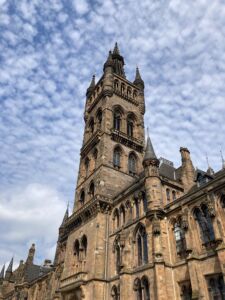
Tower at the rear of the Gilbert Scott Building.
Rachel Sandison OBE, Deputy Vice Chancellor for External Engagement and Vice Principal for External Relations, as well as the Scottish Government Trade and Investment Envoy for International Education and a US-UK Fulbright Commission board member, introduced the university’s new strategic plan for the next decade: “World Changing Glasgow: University for the World.” Celebrating 575 years of impact, the University of Glasgow has been “for the world since 1451,” but, as the message throughout the day made clear, they are just getting started. There was a strong emphasis on global impact and sustainability—addressing global challenges, building a global community, strengthening global partnerships, and investing in healthy and equitable futures.
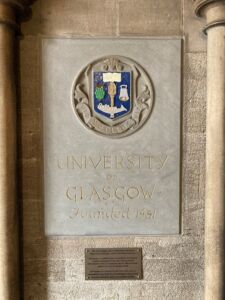
A stone plaque in the courtyard with the university’s seal at the top and “University of Glasgow Founded 1451” in gold below.
Of note on the funding front are the rolling merit-based scholarships (need-based scholarships are unavailable to international students) available to applicants (no additional application necessary). A significant number of global leadership awards, valued at £10,000 each, are awarded annually, and they offer a neat 20% (soon to be 15%) alumni tuition discount for those who previously studied at the university in some capacity; individual departments also have some funding available. Unfortunately, awards cannot be stacked.
Student-led campus tours highlighted student spaces, including the new James McCune Smith Learning Hub named for the first African American to earn a medical degree, awarded by the University of Glasgow in 1837. While not on the tour, other important campus spaces include the UK’s largest teaching hospital and the forthcoming Keystone Building, which will house the engineering program. Glasgow also has off-site locations for the School of Veterinary Medicine (the Garscube campus) and the School of Social and Environmental Sustainability (the Dumfries campus).
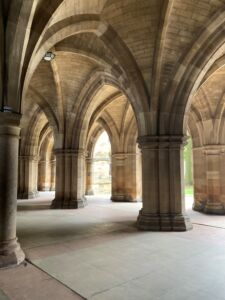
The Cloisters (also known as the Undercroft), which connect the East and West Quadrangles.
The highlight of our visit was the student panel, with seven postgraduate students from a range of disciplines sharing candidly about their experiences at the university. Ranging from law to museum studies to global health, they spoke about how diverse their cohorts are; international students representing 140 nationalities make up about one-third of the student body. They all also commented on how much the city feels like home—Glasgow lives up to its reputation as the friendliest city in the UK! Reasons for choosing the university included its reputation (Glasgow’s museum studies is a well-regarded program), the availability of a niche subject (fantasy studies), and the appeal of a one-year program, which would allow earlier entry into the workforce to help pay off any loans. The career services have been an excellent resource for helping students consider future job prospects and connect with industry, although, as with many things at Glasgow, students noted that resources need to be sought out. One of the most significant challenges named was that cohorts are expanding and the student body is outgrowing current university resources; the English Literature: Fantasy program, for example, has grown from about 15 to 34 students. Because of this, the assignment of and access to dissertation supervisors have become a little more challenging, with students noting increased pressure to make the most of their limited meetings. Non-academic challenges include that off-campus jobs are hard to come by. Despite these challenges, all seemed incredibly happy with their choice to study at the University of Glasgow and are in the throes of finishing up their dissertations by the end of the summer.
As you can see, our visit was packed with information! We had a free afternoon and evening to decompress; some explored the city by going to the Botanic Gardens or the Kelvingrove Art Gallery and Museum, both close to the university in the West End. Personally, I did a bit of laundry in the student accommodations before heading out with a group to the city center for some delicious Indian food at Chakoo Bombay and to see James Acaster’s new comedy show (or, more accurately, the UK’s premier James Acaster tribute act, Craig Simons) at the King’s Theatre. All in all, a fantastic day was had in Glasgow!
Briana Chace (she/her)
Associate Director of Fellowships
Mount Holyoke College