

After our rather adventurous and circuitous arrival to our St Andrews [punctuation accurate to local convention!] accommodations and a lovely formal dinner in Lower College Hall Wednesday evening, we emerged around 9:30 PM into a quintessentially Scottish foggy night. A crew of about 12 headed to Central Bar in hopes of sucking up some local ambience during the Scotland-Brazil World Cup match. Alas, the match did not go well for the Scots.
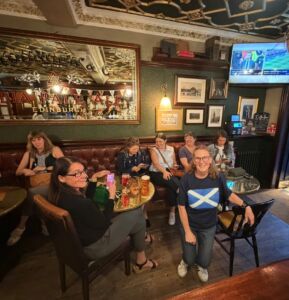
NAFANs in a St. Andrews pub watching the Scotland World Cup match
Thursday morning, we headed back to campus for a morning with St Andrews and Marshall staff. We gathered in the J.F. Allen physics and astronomy building, hearing first from Dean of Graduate Studies Morven Shearer, who shared that St Andrews has roughly 10,000 students, 2,000 of them postgrads. The total city population of St Andrews is 20,000—including students! It’s true that what might seem stiflingly small to students from major urban centers or large campuses might feel spot-on to those from smaller communities.
We learned that St Andrews has a dedicated music centre, even though they don’t offer degrees in music, and that sport is quite big there, too – obviously including golf.
Staff shared that St. Andrews accepts applications on a rolling basis, with decisions usually offered within three weeks. They offer scholarships based on merit, need, and for sport, all within a single application. Students are encouraged to not wait for an offer of admission to apply for these awards.
Next we had a session on the Marshall Scholarship with John Raine, Commission Chair; familiar-to-NAFAns staffers Haley Addison and Stephanie Berke; and two current Marshall scholars, Kendra and Kyle. It was a lovely coincidence that, as a NAFAn from the state of Indiana who happened to be assigned this day to blog, the two Marshall scholars were from Notre Dame and Indiana University and happened to know our institution’s recent Marshall well.
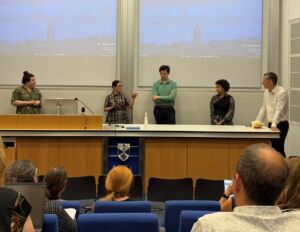
Marshall Commission representatives and current scholars on a panel
Kyle and Kendra shared their areas of study and research, their approaches to selecting universities and programmes, and their takes on addressing the ambassadorial potential question in the Marshall application. Commission Chairman Raine also shared his thoughts on the ambassadorial piece, saying they’re looking for students’ ability to project as leaders, for those who aren’t afraid to use their voice, and for those who take initiative, demonstrate curiosity, and who will take opportunities to “have a go.”
One wonderful piece of advice from the scholars was to assess your strengths and weaknesses heading into interview, so that you are prepared to address them should you be challenged there.
Next we heard about postgraduate programs in computer science. St Andrews considers ethical, sustainable, transparent , and human-centered approaches and works to balance foundational concepts, practical experience, and the latest developments, ultimately encouraging independent learners and thinkers.
After this, we learned about the new business school, which came out of a merger of their management and economics programs. They offer tracks in management, finance, economics, and an MPP and are quite quantitative in approach. They also have an agreement with University Grenoble in France, wherein students complete a year at St Andrews and a year at Grenoble, then have a work placement, and ultimately end up with double degree.
Lastly, the international relations program was highlighted. Student cohorts are typically in the range of 10-20, and the program tends to be quite popular with US students. Their emphasis is more historical, ethical, and theoretical, rather than emphasizing mathematical/statistical. It is the largest IR school in the UK in terms of the number of faculty and range of topics offered.
Next we were then treated to a panel of three US students, who spoke to their experiences with their academic programs, adjusting to postgraduate education (and life!) in the UK, and differences from US higher education. Their comments mirrored what we have heard again and again at campuses on the tour, regarding the need for self-direction, independence, student outreach to faculty supervisors as needed, and understanding of grading differences. All three stressed how pleased they were with faculty availability and support.
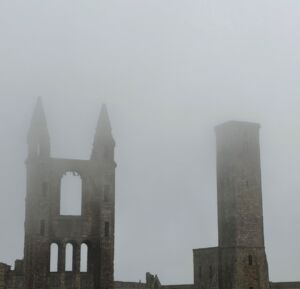
The fog around St. Andrews Cathedral
After the presentations concluded, many NAFAns used our remaining time after lunch to explore the beautiful small, ancient town of St Andrews—whether that meant heading over to see the Royal and Ancient golf course, locate that strip of beach where the famous scene from Chariots of Fire was filmed, tootle around the (few!) streets that make up the town, or head to the castle ruins along the shore. A bit of the previous night’s fog was still with us.

St. Andrews Cathedral, the ruins of Scotland’s former largest church
I think those of us from smaller campuses and more rural settings—not to mention history aficionados—were quite enamored of this lovely, quaint community by the sea! And with its ranking of 2nd in academic excellence in the UK and its pledge of “transformative education,” many of us came away imagining we could strongly recommend St Andrews to our students.
-Susan Albrecht (she/her),
Director of Fellowships (and NAFA Secretary 2025-27), Wabash College