

Two universities and a very full day.
Yesterday was a day off and it was finally quite a bit cooler, which meant everyone rolled into the morning buzzy and ready to go which is good because as a double day we needed all the energy we could muster! The combo of UCL and Imperial was dynamic, exciting, and meant that we got to see two world class institutions with wildly different foci. Both left us equally fired up about what is out there for our students. Here is what stuck with me (beyond the desire to read a million more articles by the professors who talked to us).
UCL: big, bold, and built for interdisciplinary inquiry
UCL wears its origin story proudly, and I loved it for that. This was the university founded to open doors, the first in England to welcome students regardless of background and the first to award degrees to women. More than a century later that spirit is still the whole point.
It is also enormous in the best way. Roughly 55,000 students, split evenly between undergrad and postgrad, with half coming from outside the UK. Ranked 8th in the world, second only to Oxford for research firepower, and home to 33 Nobel laureates including AI’s own Geoffrey Hinton. Eleven faculties, more than 700 postgraduate degrees, 17 libraries, and over 400 clubs spread across campuses with their own distinct vibes. If a student can dream it, there is probably a path here for it.
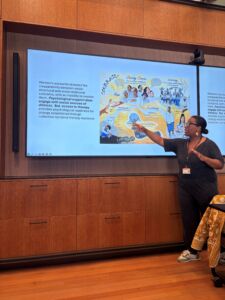
Professor Rochelle Burgess talks about her work in Global Mental Health with Courage+ a community lead health intervention program in Johannesburg, South Africa.
Our time on campus was brief but genuinely fascinating. What I most wanted our group to hear was the sheer range of projects and research on offer, and the taster lectures delivered. Dr. Guyanne Wilson asked whether English worldwide is quietly turning American, and made a convincing case that language is soft power worth studying (I also now find myself actively listening to the variety of English words people use and the construction of language in the variety of news sources I consume). Professor Rochelle Burgess moved the whole room with her work in global mental health, arguing for care that is community-led rather than community-targeted, with examples from Johannesburg to London. And Dr. Mehdi Hasan introduced the MSc in Cancer and its bench-to-bedside ties to UCLH and the Royal Free, a sobering reminder of why this work matters when nearly 1 in 2 of us will face a cancer diagnosis in our lifetime (!).
For our students, the welcome at UCL is real. About 1,400 US students and climbing, an American Society that hosts Thanksgiving and Super Bowl watch parties, and a fellowship record to envy: 29 Marshall Scholars and 14 Fulbright Scholars, with scholar networking events each November and July. The career and entrepreneurship support is genuinely hands-on, right down to a startup incubator near Kings Cross that has pulled in 100 million pounds and employs over a thousand people. The faculty are also incredibly engaged with their students. The opportunities for research are beautifully varied and in the meet-and-greet networking break it was clear the professors are really excited to work with MSc students which was genuinely lovely to see.
Lunch was a quick affair at The Brunswick Centre, the choose-your-own, grab-and-go kind, which is always fun with a group because everyone wanders off and comes back with something different. I treated myself to a Ben’s Cookies milk chocolate and orange cookie, and one bite sent me straight back to my own study abroad days here in the UK. Some flavors are little time machines.
Imperial: science with its sleeves rolled up
Then we took the tube (wahoo!) and crossed the city to Imperial, in the heart of the museum quarter. We arrived to an absolute swarm of schoolboys, easily hundreds of them, ages twelve to eighteen, pouring out of the museums nearby into the tube. It was a fun bit of chaos to walk through on our way in and also made me super grateful I never had to wear a tie to school, I’m pretty sure it would never have made it through the day.
Inside Imperial, the energy shifted from breadth to sheer momentum. My favorite surprise came courtesy of Dr. Stefano Sandrone and his whirlwind “3,500 Years of Neuroscience in 25 Minutes.” He opened with the Edwin Smith Papyrus, and I will admit the Egyptologist who has vivid memories of my Ancient Egyptian Medical Texts class in grad school was excited to see it included alongside the western history of Neuroscience.
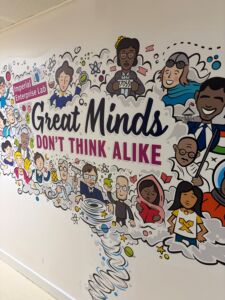
Wall decal just outside the Innovation Lab at Imperial College.
This then led into the science of tomorrow as Dr. Elena Dieckmann closed us out with global sustainable engineering, and it played like a highlight reel from the future. Student inventions that capture the pollution shedding off car tyres, robots that inspect wind turbine blades, a system that pulls particulates out of the air, even algae turned into energy. They feed into the MSc in Cleantech Innovation at the Dyson School of Design Engineering, where students keep their own IP, build a real venture in teams, and do a startup placement. Half to sixty percent of them launch a company by graduation. It was truly mind blowing.
I can really see Imperial being an incredible home for students engaged in STEM and entrepreneurship. The student panel really highlighted the depth and breadth of the offerings and the types of degrees and research our students can dig into.
Big Take Away?
UCL gives our students breadth, history, and a dynamic engaging place to learn and launch. Imperial gives them focus and a straight line from idea to impact.
Now on to Manchester!
-Alicia Cunningham-Bryant (she/hers)
Dean of the Honors College and Kim T. Adamson Chair, Westminster University