

Royal Veterinary College, University of London
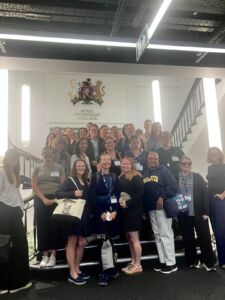
NAFA Study Tour group photo at the Royal Veterinary College in London
Day 11 on the NAFA UK Study Tour started with our group saying goodbye to the University College of London dorms, as our weekend in London quickly wrapped up. This morning, our visit is to the Royal Veterinary College (RVC), one of 17 institutions that are a part of the University of London federation.
RVC was established in 1791, coming out of the UK racehorse industry’s need for veterinary medicine and research. Researchers in animal physiology were brought over from France, which led to the eventual founding of the college.
We were welcomed by Imelda McGonnell, Vice Principal of Students and Professor of Cell and Development Biology, and Nina Madleline Davies, Chief International Officer & Director of Strategic Partnerships.
RVC is ranked as the #1 veterinary school in the world by QS World University Rankings. RVC has 2500 students in total, a tight-knit community spread out over the Camden and Hawkshead campuses. RVC takes advantage of its walking distance proximity to the London Zoo as well as the Hawkshead campus, a 20-minute trip by train where clinical sections and animal hospitals are located. From there, nearby is Boltons Park Farm, a working small commercial farm where students can learn about research and animal husbandry. They also have a milkshake machine, which sadly we did not visit, as we stayed on the main campus in Camden.
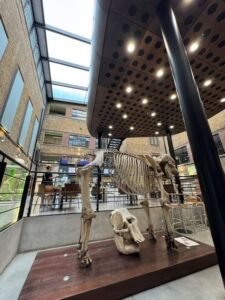
Animal skeleton during our coffee and breakfast break at the RVC
RVC collaborates with a number of international organizations such as the Food and Agriculture Organization of the United Nations, the World Organisation for Animal Health (Founded as OIE), and International Livestock Research Institute (CGIAR). RVC faculty discussed additional ties to UK agencies such as the Department for Environment Food & Rural Affairs.
Degrees
RVC hosts a number of different undergraduate and graduate degrees across medicine and research. The veterinary school is the founding institution, but they stressed the college’s connection with One World Health: “we work on the human side to improve animal and human health worldwide.”
The veterinary medicine degree has full accreditation by international accrediting organizations, allowing students to practice through reciprocal agreements in other countries. The college has just undergone reaccreditation by seven organizations in last eight months. Students from 70-80 countries are represented each year and 90+ countries are represented by staff.
The veterinary medicine degree is a 5-year program in the UK, with a 4-year option for students who bring in a graduate degree in a relevant field. 32% of students in the 5-year program are from the United States, and almost 100% make up the 4-year program. 900 US students apply each year, with about 1 in 7 gaining acceptance. All graduating veterinary medics have to qualify as surgeons and everyone graduates as an omni-competent vet, with additional residencies furthering specializations.
In addition to veterinary medicine, RVC offers a veterinary nursing degree, which is a longstanding fixture in the UK, but has only recently grown in popularity globally. Nursing degrees equip students to perform day-to-day animal care, plus conduct some procedures like anesthesia or emergency care.
On the Postgraduate master’s side, RVC offers the One Health MSc, which is co-taught with the London School of Hygiene and Tropical Medicine, The Wild Animal Biology MSc is coordinated with the London Zoo. Additional master’s degrees include Veterinary Epidemiology, Wild Animal Health, Veterinary Education, and Science Education.
Faculty at RVC recommended that the master’s degrees are a good opportunity to pivot to veterinary and animal research fields, making a student more competitive for veterinary medicine or PhD programs. Finally, RVC is open to undergraduate international students coming on exchange or study abroad to “try it before you buy it,” however these experiences will not transfer into veterinary medicine to qualify for the expedited 4-year degree.
Laboratory Skills Tour and Faculty Lectures
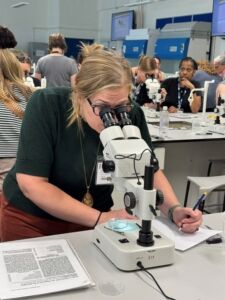
Looking through microscopes at zebrafish embryos
After being introduced to RVC, our group conducted a tour of libraries and laboratories, which included a live demonstration to look at zebrafish embryos under a microscope. Our group was engaged by a series of lectures by Dr. María Díez León – Associate Professor in Animal welfare, Dr. Mat Hennessey – Lecturer in Agribusiness, and Dirk Werling – Professor of Molecular Immunology and Director for the Centre for Vaccinology and Regenerative Medicine. Faculty presented the interdisciplinary connections of their work, which include topics on management and ethics of animal use and overall assessment of animal welfare. Faculty demonstrated the global scope of their research and its impact on local policy, stretching as far as Indonesia. Faculty also presented several snapshots of U.S.-based international students participating in their programs, with outcomes leading to jobs in laboratories to entrance into competitive veterinary medicine and PhD programs.
Scholarship Opportunities
Due to its small size, RVC does not offer extensive merit-based scholarship opportunities to international students, unlike other larger universities we visited. The Fulbright RVC award allows students to pursue either a 1-year taught or 1-year research master’s degree. More information on the RVC Fulbright award can be found here (link opens in a new tab).
Onward to Manchester
After an exciting visit to RVC, our group gathered at midday for a 2-hour journey from London’s Euston Station to Manchester, where we will tour the University of Manchester. After a train cancellation due to some “cows on the tracks” and a surprise platform change, we are running almost on schedule to arrive in Manchester.
Drew Chapman (he/him)
Director of Nationally Competitive Awards
The University of Texas at San Antonio