

After a sound night’s sleep (back in air-conditioned rooms!) and a hearty hotel breakfast, we walked to the University of Manchester and were greeted by members of the International Student Recruitment team. We enthusiastically received the latest addition to our growing tote bag collection, containing an assortment of bee-themed items. The bee is a symbol associated with both the university and the city of Manchester, representing the “worker bee” and reflecting the city’s famed industrial history as well as its enduring activity and unity. In addition to being the birthplace of the industrial revolution, we learned that Manchester holds a central place in the histories of communism, women’s suffrage, veganism, AI, and much more. Mancunians are rightly proud of their legacy and their present, including the recent rise of Andy Burnham within the Labour Party (he may soon become the Prime Minister, but locals know him as their longtime mayor!)
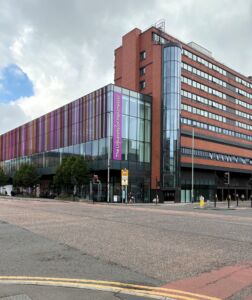
Manchester’s campus as we arrived
The University of Manchester is quite large (~44,000 students). Two thirds of the student body study within the Faculty of Humanities, which covers all of the non-STEM fields offered at Manchester. However, with a student body of that size, the remaining third that studies in the Faculty of Biology, Medicine and Health and the Faculty of Science and Engineering still accounts for quite a large number of students! A Russell Group university, Manchester is ranked 40th in the world, 8th in the UK, and number one in the world for sustainability impact (progress toward the UN’s Sustainable Development Goals). Perhaps unsurprisingly, Manchester’s School of Environment, Education and Development offers an array of highly ranked, innovative postgraduate courses. Interdisciplinary research platforms at the University include Creative Manchester, Digital Futures, Healthier Futures, Policy@Manchester, and Sustainable Futures. To help them access these resources, North American “PGT” (postgraduate taught) applicants are eligible to apply for institutional merit-based partial tuition scholarships called the Global Futures Scholarships and the NAFUM Scholarships.
Dr. Angie Wilson, the Associate Vice President – International, is a Texan who first came to the UK on a Rotary International Scholarship. Her presentation touched on numerous examples of Manchester’s institutional values, and their alignment with those of the surrounding city. For instance, Manchester’s Global Development Institute is committed to co-creation with their partners (in contrast to colonial practices of the past), and the city’s Abe Lincoln statue commemorates the history of local textile factories refusing to process cotton picked by enslaved Americans during the Civil War.
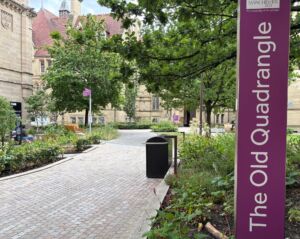
View of the Old Quadrangle area
At lunch (at “the Beehive”), I had the pleasure of chatting with Dr. Kathrine Smith, faculty in Visual Anthropology. What’s that, you may ask? Ethnographic filmmaking! I’ll never get tired of learning about new-to-me courses and subfields. If Dr. Smith had led our campus tour, she would have taken us to the desk in Chetham’s Library where Marx and Engels collaborated in 1845, as well as past the home of the Pankhurst family, who were active in political organizing for women’s suffrage – stops she makes with her Urban Anthropology class. Instead, our campus tour stops included the Business School facilities, School of Engineering facilities, the Students’ Union, and the lovely Old Quadrangle area – all top-notch. Also worth noting; the student accommodation we toured (Denmark Road) was easily my favorite that we’ve seen thus far.
We ended our campus visit with a student panel, featuring a Fulbrighter and 3 NAFUM recipients. As with all of the panels we’ve enjoyed, these students did a great job articulating their experiences with the differences between US and UK graduate education, as well as their strategies for making the very most of their short time as master’s students in the UK. Themes that have echoed across the UK include adaptability, the importance of taking initiative, and the need to be self-governing.
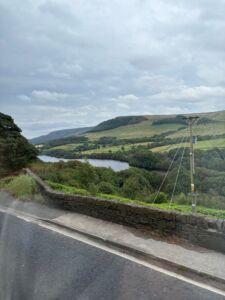
View from the coach as we traveled through the Peak District to Sheffield
After a group photo and goodbyes to our hosts, it was time to travel to Sheffield. The views out of our coach windows of the Peak District National Park were absolutely spectacular.
My first impression of Sheffield was that it reminded me of Pittsburgh, though that may be the power of suggestion, as a prominent sign welcomed us to “Steel City.” After checking in, many of us ventured to a vibrant food hall, where my table devoured a massive Biscoff French toast sundae. It was another full, wonderful day on the UK Study Tour!
Lauren Orr (she/her)
Program Manager, Fellowships & High-Impact Learning
Wayne State University