

Cambridge University (founded in 1209), the fruit accent on the pain aux raisins of our NAFA-UK journey. The swirl of our travels revealed some creamy, some buttery, and some crunchy institutions -all were delicious to devour -but really (literally?), the Showstopper Challenge was Cambridge. While our first day was spent enjoying its ambiance (boats, bitters, and boys with voices that lifted the rafters of King’s College Chapel), the second day’s takeaway was funding opportunities for postgraduates. Between the two-days of meticulously orchestrated events, from The Fitzwiliam Museum to the Corpus Clock, with invited access to five colleges, Nathan, Emily, and Luke truly fed us on many of the delights that Cambridge has to offer our students.
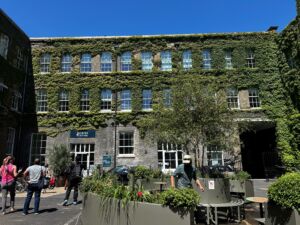
Walking toward the Gates-Cambridge building
Cambridge University’s fundraising goal is to support 100% of their doctoral candidates; currently they fully fund 64% of doctoral and nearly 14% of master’s level students (29% of all postgraduates), to the tune of more than £100 million. There are many avenues through which students find funding, including their colleges, departments, UK research councils, studentships, and external sponsors. Unlike many of the universities on this tour, Cambridge postgrads can stack their awards so long as they do not exceed set expense levels. Step one for our students should be to investigate funding opportunities here.
Our hosts focused our attentions by looking at a broad umbrella scholarship funder (Cambridge Trust), a prestigious flagship scholarship (Gates-Cambridge), and finally a one-year, college-specific STEM award (Churchill).
Rachel Coupe, Director of Awards for the Cambridge Trust walked us through the application process -apply to your course of study by its deadline, finish your university application, tick the Cambridge Trust box to receive consideration and/or information for awards under their purview -some are available without application, while others, not so much. Each year they invest £40 million in scholars via 400 awards; one of their listed partners is Marshall.
Gates-Cambridge provides an avenue for 75 fully-funded scholarships for masters or doctorates (30:70 respectively) to international scholars with a demonstrated capacity for leadership and “committed to changing people’s lives”, so long as you are not from the UK. The growing alumni network and rising costs of graduate education globally have vaulted this award from highly competitive to “touched by angels” (a phrase tossed about while we punted down the Cam on Sunday afternoon); last year they received 9000 applications. The scholars we met were divine and showed no mere mortal’s path to this award. One had received a Goldwater, one had several years’ experience working for a non-profit, and one had failed twice before being granted his wings. While not a college, Gates-Cambridge creates a community of cross-disciplinary, service-minded scholars who will change the world. Many more billionaires should attempt redemption through hands-off philanthropy like this.
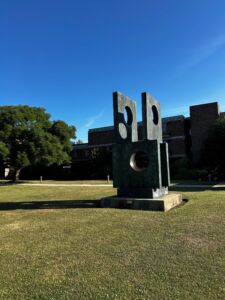
Contemporary sculpture on the grounds of Churchill College
Churchill College, founded in 1960 (evidenced by our dormitory’s architecture), provides a college-specific, fully-funded, one-year scholarship for STEM students. Unlike other applications, we the undergraduate institutions, nominate our top two candidates, providing a pool of 100-140 applications annually for the 16 scholars and two science policy awards. In the words of Rita Monson, Senior Tutor (aka “dean” of the college), this is a great opportunity for students to tailor their future doctoral research ideas or test those “MD/PhD waters” and decide if research is a fit. Dr. Monson helps students find research faculty from departments outside the student’s own and explained that when faculty accept a student to mentor, they also provide research support (£) too.
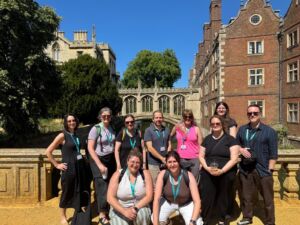
NAFAns in front of the Bridge of Sighs
After lunching on finger sandwiches, we divided and toured either St. Johns or Churchill colleges. Those of us who enjoyed the 16th century, King Henry VIII chartered college, with its prime location on the Cam, and its iconic Bridge of Sighs, pitied those who could not join us. Groups rejoined to finish out the day talking physics and enjoying the copious air conditioning. Again, an enormous thank you to the International Student Recruitment Team for planning and hosting our time; it was so worthy of a Hollywood handshake!
Ann Kroll Lerner (she/her)
Associate Dean of Students and Director of Fellowships, Opportunities & Undergraduate Research
Patrick Leahy Honors College
University of Vermont