

Glasgow -> Edinburgh -> St. Andrews
Fasten your seatbelts (as our bus driver Ali told us) for a wild ride as we traveled from west to east in Scotland! We woke up in the wee hours of the morning, grabbed our nicely packed breakfast bags, and departed Glasgow for Edinburgh.
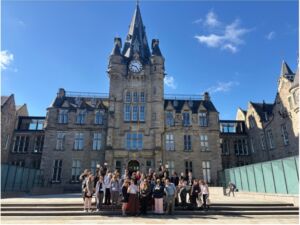
Study tour group photo in front of the Edinburgh Futures Institute
Upon arrival at Edinburgh, we were ushered into the new Edinburgh Futures Institute (EFI), which has only been opened for a few years. Previously, it housed the Old Royal Infirmary (1879-2003), which is reflected in the motto and sayings on the building – “Patet Omnibus” or “Open to all,” “I was a stranger and ye took me in,” and “I was sick and ye visited me.”
It now operates as one of the largest centers for interdisciplinary learning, research, and innovation in Europe! The University of Edinburgh emphasized the importance of moving to more interdisciplinary work, and this building is a key part in that. Located in the heart of Edinburgh, it was clear that students have access to historic landmarks, a vibrant city, and the ability to travel around the UK.
There are over 49,000 students from more than 160 countries worldwide, and the city of Edinburgh is home to approximately 100,000 students. The University of Edinburgh is equipped to handle and help students with 18,000 staff, with one academic staff member to every six students. Important note: Staff is also the term used to encompass faculty.
What was most striking within Scotland was the connection to the American Revolution, especially at the University of Edinburgh. Much of this arose due to the Scottish Enlightenment in the 18th and early 19th centuries. “Life, Liberty, and the Pursuit of Happiness” was born from the older phrase “Life, Liberty, and Property” that was present in the UK at that time. During the Scottish Enlightenment, John Locke heavily emphasized human fulfillment, writing that that “pursuit of true and solid happiness” is the “foundation of liberty.”
“Happiness,” however, had a different meaning from what we know it as today. It was defined as eudaimonia from the ancient Greek concept popularized by Aristotle. In essence, it’s more than a temporary emotion or feeling of pleasure, but this idea that by focusing on our purpose, self-realization, and meaning of life, we will create a lifetime of happiness AND a community where people can thrive. Eudaimonia = ergon (function) + arete (virtue), and phronesis (practical wisdom). Personally, I like this idea of happiness more. In our modern world, we are often “chasing” a feeling of happiness and not this lifetime idea of what it means to be “happy” for ourselves and our community.
In addition to the language brought over from Scotland, many alumni influenced how the US was built. Edinburgh alumni went on to found five of the seven Ivy League medical schools. The alumnus Reverand Dr. John Witherspoon (MA 1739) was the only clergyman to sign the Declaration of Independence and went on to become the president of Princeton University (previously the College of New Jersey). Other important alumni in American Independence include James Wilson and Benjamin Rush, but I will let you all look them up! Moreover, young “Americans” saw the University of Edinburgh as an important place of new ideas that could influence the new country of the United States of America. For instance, in 1776, more than 10% of the students at the University of Edinburgh came from North America. It seems that our love with the city and University of Edinburgh has not changed much. We still see this as a place with a wealth of knowledge to help us change the world.
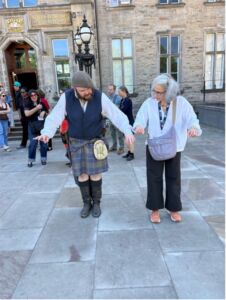
Tour guide Russell showing NAFAn Lara Kusnetzky how to fold a kilt
Beyond the immense history of the city and University of Edinburgh, we were treated to academic taster lectures from the biological sciences, social and political sciences, business, and geosciences. They were all excellent, and the quality of professors is clear here. One of our favorite parts of visiting these universities are hearing from the students themselves. We were lucky enough to hear from a variety of students studying Medieval History, Cardiovascular Science, Social Anthropology, Climate Change Management, and Global Strategy and Sustainability. Needless to say, I’m always impressed by students studying amazing things and this group was no exception. I wouldn’t be surprised to see their names as part of the future discoveries and innovations that we’ll have.
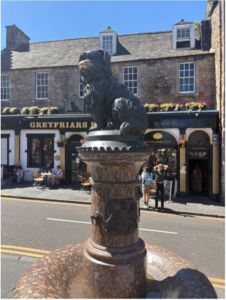
The statue of “wee” Greyfriars Bobby
We were fortunate to be taken on a tour by the lovely Russell, dressed in his traditional attire! He taught a few of us how to fold a kilt, and I now have so much more appreciation for the craft of folding a kilt! There is lots of history inside and outside the ancient walls of Edinburgh. I won’t go too in-depth, but my favorite part of the tour was when we went to the wee dog statue, Greyfriars Bobby. The story is that Bobby belonged to John Gray, an Edinburgh City Police watchman. When John passed away in 1858, Bobby followed his owner’s remains to the Greyfriars Churchyard and remained there for 14 years until his own death. While there may be disputes about the accuracy of this story, what’s more important is the sentiment. There was something so precious and intangibly “human” about this story that I can’t help but believe it.
After the tour, lunch, and the wonderful academic taster lectures, we had to unfortunately depart. It was clear that the University of Edinburgh had so much more to show and tell us, but we also had much more to learn about other universities. We only get to sample a bit of each place, and we KNOW there’s so much more to experience and learn. Oh, what I wouldn’t give to be a student at each university! We wish we could spend weeks at each place to really understand the culture and life at each place, but alas, we’ve got a schedule to keep!
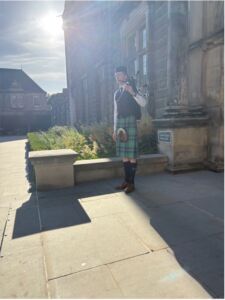
A bagpiper playing as NAFAns went into dinner at St. Andrews
Our amazing Fulbright guide, Jess, made sure we were all on the bus and continued our journey to St. Andrews. I honestly don’t know how Jess is surviving 35 Americans throughout this time and I am impressed! Traveling in the countryside of Scotland, we saw rolling green hills, many sheep, goats, and cows. It was a beautiful ride, and we arrived at St. Andrews just in time for our reception and dinner with the Marshall Aid Commemoration Commission. As we entered St. Andrew’s campus and made our way to the dinner reception, a wee bagpipe player was playing a tune for us. It was a lovely way to be greeted, and I wouldn’t mind that at my own university every day.
We enjoyed not only the food, but the ability to talk with both the Marshall representatives and some current UKSI and Marshall students. Again, I was blown away by the caliber of students we get to talk with. Talking with each student, I noticed just how hopeful I started to become about the world at a time when so much is happening. Each place we visit, I am inspired by the students, staff, and faculty that are doing the hard work of trying to change our world for the better.
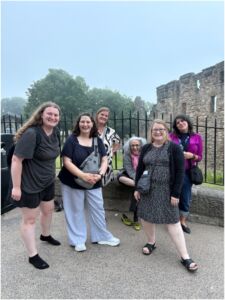
NAFAns enjoying the “haar” of St. Andrews
We wrapped up our evening, both exhausted and somehow energized. I was delighted by the haar (a thick, cold sea fog from the North Sea) that had enveloped St. Andrews and a few of us made our way down to the beach to dip our feet into the water. There is a “May Dip” where every May 1st at sunrise, hundreds of students gather at East Sands to collectively run into the sea to wash away their “academic sins” and gain good luck for the upcoming exams.
The cold water felt like a relief after a long day and the locals making a wee beach bonfire added to the refreshing ambiance. We finally made our way back to our Marconi dorms in St. Andrews and tucked ourselves into bed, as tunes of bagpipes filled our heads.
Alison Shimko (she/her/hers)
Associate Director, University of Utah
P.S. “Wee” has become my new favorite word, if you can’t tell from this post.