

Friday, June 26: This was a long day for our intrepid NAFANs as we visited both Durham and Northumbria Universities. Despite their close geographic proximity, the cities and universities are quite different in setting and character—and both full of excellent opportunities for postgraduate study.

Durham Cathedral, UNESCO World Heritage site
Durham is the fourth oldest uni in the UK (est.1832) and has about 22,000 students (4500 postgraduate). A research-intensive university, it ranks in the top 100 universities globally. It’s located in the northeast of England, in the small historic city of Durham (pop. 42,000). At the city center are the UNESCO world heritage sites Durham Cathedral (c. 1093 -1133) and Castle (c. 1072)–some of the best surviving examples of Norman architecture. We didn’t have time to go inside the cathedral, but you can see parts of it in the first two Harry Potter films. The Castle is one of the 17 residential colleges at Durham University. The colleges are a mix of very old and newer buildings, offer catered and self-catered options, and include student residents from all disciplines.
We had faculty presentations from the sciences, business school, and arts, humanities and social sciences, as well as conversations with current students, including a Fulbrighter (who is doing fascinating work with the Durham Heart engineering project in developing an artificial heart). Most of the focus was on taught master’s programs, with a wee bit of attention to Phd placements. There’s a large array of postgraduate degree offerings (check the website!). But one type new to many of us was conversion degree programs that allow students without prior study in the field to jump in at the graduate level. Examples include degree options in psychology, environment and sustainability and data science. Some of the areas highlighted included engineering, sustainability, theater and music, English, archeology (including nearby excavations of a Roman fort) and business programs, including combined science and business programs. The business school is triple-accredited, making it attractive for North American students interested in working in the US and/or Europe. The school has strong connections to London-based businesses, with an active recruiting scene on campus. There’s also a rich array of student organizations, including loads of theater, musical theater, comedy, opera, and yes, a Taylor Swift Society.
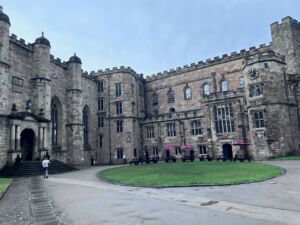
Durham University campus
Student athletes will also find a welcome home at Durham with a long list of sports. There’s everything from American football to wheelchair basketball—even billiards and clay pigeon shooting in addition to standard American sports. There are scholarships for athletes as well as merit-based scholarships; the university anticipates adding an arts scholarship in the fall. These are partial scholarships (and not stackable), so most students we talked with covered expenses through multiple sources: loans, personal funds, and part-time jobs—and the Fulbright, of course. Unlike Glasgow, students reported no difficulties in finding positions on or off-campus. Applicants need a minimum 2:1 Honors degree (3.25 GPA) for admission; much higher GPAs are required for merit scholarships.
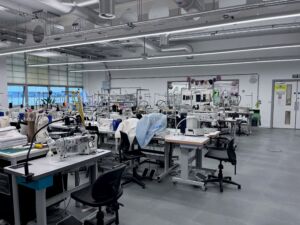
Inside a fashion-focused classroom at Northumbria University
After lunch, we took a half-hour bus ride to Northumbria University in Newcastle. The city and university were a stark contrast to Durham—think traditional and historical vs. progressive and community-focused. Newcastle is home to 320,000 people, 2 universities, one of only 3 metro systems in the UK, and a football team. (Liverpool fans in the group kept a low profile.) Northumbria is different than the other institutions we’ve visited. For starters, it’s a “modern” university—meaning it was established post-1992. Formed through the union of three regional institutions, it’s grown to one of the UK’s largest universities with 37,000 students from 140 countries. Still, it retains a strong connection to Newcastle and surrounding region. There’s also a notable emphasis on inclusion. Sixty percent of students are from Northeast England; forty percent come from “low participation” educational backgrounds. And there were Pride banners up and down the central walkway. This is a place that takes seriously its mission to innovate, create knowledge and drive social mobility. It was ranked 23rd in the UK for research power (2021 Research Excellence Framework) and has climbed more than 20 places in the Complete University Guide rankings in the past seven years.

An example of student work from Northumbria University
Northumbria faculty is divided into three areas: Society and Culture, Science and Environment, and Health and Wellbeing, so while there are some typical programs like law, business, humanities even those may be structured differently. The arts and design area offers degrees in art conservation, fashion design, commercial interior design, furniture design, architecture, communication, and much more. There is also a London campus offering luxury brand marketing and cybersecurity programs. We spent most of our time in the arts and design building, touring creative workspaces for different programs. Think woodshop, looms and sewing machines on steroids. The fashion display in the entry hall was testament to the creativity and technical prowess that flourishes there. Although most of our visit focused on the arts, technology and innovation are areas of strength as well. Look out for the opening soon of the North East Space Skills and Technology Centre (NESST), a £50M facility developed by Northumbria with investment from the UK Space Agency and Lockheed Martin. This university-industry partnership aims to transform the UK space economy—and with Northumbria’s strong mission, that seems entirely possible.
We finished off the day with a lovely dinner and a “pub quiz” test of our UK knowledge. Factoid highlights: 100 million cups of tea are consumed annually in the UK, there are 162 institutions of higher education, and there are six places in Europe where people drive on the left (all island nations, which makes sense—it would be too confusing otherwise).
Lisa Gates (she/her/hers)
Associate Dean for Fellowships and Research, Middlebury College